Critic Notes of Beba Marsano vai alla versione italiana
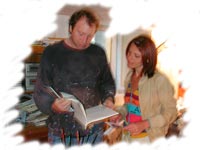 "INCANDESCENCE"
Crovetto
has often wondered what he woud have been like to encounter the light of Tuscany.
How would his eyes have reacted, how his spirit would have been affected and
most importantly, what influence would have been on hi painting. He knew that
the light awaiting him there was different from that he had exeperienced thus
far. It would be soft, velvety, submissive, and sweetly radiating. But it
would also be terse, crystalline and rational, cpable of calming passions
rather than in feverish insomnia, epitomisingbalance and measure, the dogma
thaugh by the painters of the Tuscan school. Such light had nothing in common
with its saturated, full-zenith counterpart in Southern France which Crovetto
had experienced during his previous two years. Nor was it similar to the vrbrant,
absolute light of Liguria, where Crovetto was born, lives and works.  The
Summer light of Siena, languidly lying on the town's monumental masonry, on
hilltop hamlets, on the countryside and the clary-rich soil enriched his palette
with previously unknown hues, strokes of gold and oachre borne of the land.
But a palette so brash and aggressive was not to be overcome by such an unfamiliar
softness. The
fauves likened their colours to "sticks of dynamite"; Crovetto in
fact esteemed the fauves and his masters, tpgether with the German artists
of the Brücke school (Kirchner, Heckel, Schmidt-Rottluff). If for Matisse
the colour was the natural expression of the emotion and for the expressionists
it was a tool for forcefully communicating social and existential suffering,
for Gian Marco Crovetto it is the language of the choice actually, the only
sincere language possible for confessing himself to others and reconcilling
the word to himself.
The
Summer light of Siena, languidly lying on the town's monumental masonry, on
hilltop hamlets, on the countryside and the clary-rich soil enriched his palette
with previously unknown hues, strokes of gold and oachre borne of the land.
But a palette so brash and aggressive was not to be overcome by such an unfamiliar
softness. The
fauves likened their colours to "sticks of dynamite"; Crovetto in
fact esteemed the fauves and his masters, tpgether with the German artists
of the Brücke school (Kirchner, Heckel, Schmidt-Rottluff). If for Matisse
the colour was the natural expression of the emotion and for the expressionists
it was a tool for forcefully communicating social and existential suffering,
for Gian Marco Crovetto it is the language of the choice actually, the only
sincere language possible for confessing himself to others and reconcilling
the word to himself.
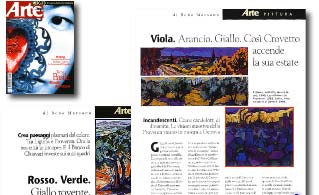 |
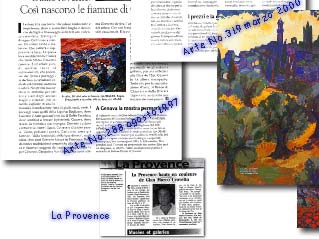
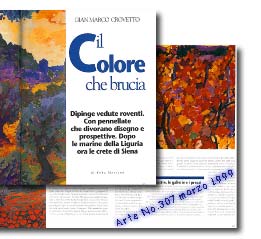
Journals talking about Crovetto
|
|
| Il Secolo XIX L a Nazione Corriere Mercantile Il Lavoro Il Golfo Arte Figaro Méditerranée Le Littoral Les Vente Du Sud-Est Nice-Matin |
Le Parisien Hebdo La Marne Sud-Ovest Les Nouvelles Publications Univer des Arts Sortir Arts Croisés La Provence Le Dauphine Connaissance des Arts |
|
 |
 |
|
